EEG fixes ADD ...
Neurofeedback in schools is a vital public issue to the taxpayers, parents,
students and citizens.
Suggested questions to your school Administration and
School Board are below.
With leadership and courage, all could benefit. The clearest case in
schools is for those with Attention Deficit Disorder. Understand this:
over 1 TOVA point per hour of neurofeedback training.
Neuofeedback training lets kids learn their way into the mainstream classroom.
The Special Ed. cost saving potential is very large. And the positive
implications are even broader.
Neurofeedback technology offers a big bang per buck. ADD/AHDH and related
problems, are prime issues faced by Special Education Programs. As costs
soar and mandates approach, the School District leadership and the Board
must choose:
Teach a skill -- or just let 'em take a pill.
The case for taking positive action:
Here are four open letters to my Administration and School Board.
Lower Merion could Lead the Nation and Set Standards
for Neurofeedback
The neurofeedback initiative links to so much of what LM stands for.
District Mission
the Lower Merion School District guarantees that all students
achieve their highest level of critical thinking and creativity
this is accomplished by individuals engaging in innovative, active experiences
tailored to varied ways of learning, and in partnership with our community.
Strategic Plan
Underlying the District's approach to our new Strategic Plan
is Appreciative Inquiry. (Accentuate the Positive.)
Vision
We create an environment designed to fulfill the individual learning
needs and aspirations of each student.
Beliefs
People learn in different ways and at different rates.
Individuals learn best when actively engaged in the learning process.
The responsibility for learning rests primarily with the individual; however,
education is the shared responsibility of the student, home and family,
school, and the entire community.
Ethical conduct is essential to the quality of life.
Strategic Plan's 7 Learning And Organizational Goals
Goal #1 Understand and provide for every child.
Goal #2 Value an atmosphere in which the educational community works collaboratively
to foster the growth of its members.
Goal #3 Coordinate district systems to integrate education, technology,
information systems, human resources, facilities, transportation, business,
and food service.
Goal #4 Create a meaningful, dynamic curriculum.
Goal #5 Cultivate alternative funding and other resources to support the
educational program.
Goal #6 Provide facilities to ensure high quality educational programs.
Goal #7 Establish the flexible use of the members of the learning community:
"Tapping all Talents"
Favor the Broadest Definition and Decentralized Use for Your Schools.
The field is open for your School District to assert that Neurofeedback
is a Learning Tool appropriate for use by any student who wishes to use
it. There are no restrictions. An EEG machine is available to consumers.
The District can assert that this technology is just like books in the
library or internet access. Calling in an Assistive Technology Device
puts it into the Special Education Category governed by restrictive laws.
Call it neurotherapy and costs skyrocket for no added benefit.
Schools are the Primary Brain Altering Institution.
Education alters brains. Brain maps show large differences compared
with the unschooled. Schools fulfill their duty by creating complex and
sophisticated neural networks inside our children's heads. The District
is responsible for altering the structure of each student's brain and
brain functioning, in many ways, every day of the week. This is good.
A school does not need special permission to fulfill its mission. Teaching
brain wave control is just like teaching how to learn. That's exactly
what it is - awareness training to enhance capacity for education.
Neurofeedback is a kind of biofeedback, which is purely learning. The
goal is improved awareness leading to greater self-regulation. That it
education.
The District Should Assert the Right to do Neurofeedback.
Here is a principle worth fighting for. If a physician does neurofeedback
in her office, it is medicine. If a psychologist does neurofeedback treatment,
it is therapy. If a teacher does neurofeedback in school, then its education.
Does it really work?
Neurofeedback has been proven to aid reading, listening, speaking and
writing, and mathematics in all types of students, especially special
needs students. The "proof of efficacy" is much more substantial
than that for any of the other programs the District has already adopted
for remedial programs. If eating at the cafeteria and riding the bus are
safe, then neurofeedback is very safe.
Neurofeedback training can be offered in any classroom, in a practioner's
office, in the student's home as a stand alone unit, or via the internet
anywhere, anytime. We are dealing with a device that reads 2 millivolts
of electricity emanating from a scalp which is then shown on a screen
or handheld device. Retain the right to call neurofeedback an educational
toy, to be used at will, and control goes up and costs go way down.
Anyone can now buy EEG machines or neurofeedback devices for $1000 over
the internet and EBay. Just wear, look, learn, and improve! One can also
become certified by professional associations. Teachers can be trained
in as little as 2-4 hours of video training with ongoing phone support.
Dr. Dominic Greco, of Plymouth Meeting, PA, will release an Attention
Trainer for $300,
designed for use in the home in early 2004.
The District is given much room in defining a category and 'ownership'
of the nature of this 'intervention'. If the District could characterize
neurofeedback as educational, it would assert the largest freedom in setting
the rules because it falls directly under their purview. And sets an enlightened
precedent for others to follow.
A pilot program which includes the best and brightest students and athletes
in the district would establish the point of pan-educational benefits.
This would be a savvy introduction and 'branding' in student's minds.
I'll bet the science and engineering Olympiad students could design a
wearable wireless brainwave transmitter read by a robot. Each team member
could control separate robot functions by adjusting their neural output.
Neurofeedback devices are sold to schools with only one video tape for
instruction on use. Volunteers and college students have been trained
to do neurofeedback sessions on 2776 felons over 25 years with no bad
sessions. Re-arrest rates dropped to only 15% after 3 years.
Is it an Assistive Technology Device and Service? If you want it to be,
then yes, but this puts into the Special Ed category. It need not reside
there because of its broad use by non-disabled students. You can expect
neurofeedback to be requested as part of IEP under 504/ADA. The easiest
thing to do at first in to refer to local practitioners. Look for BCIA
certification, but this is not required.
Neurofeedback is a successful treatment with a significant proportion
of students with the following disorders (incomplete):
ADHD, alcoholism, anxiety, autism, depression, dyslexia, epilepsy, fibromyalgia,
headaches, head injury, IBS, juvenile delinquency (recidivism), mental
retardation, migraines, mild traumatic brain injury, panic, PTSD, PMS,
Reynard's, sleep disorders, speech and language impairment, dysgraphia
and dyscalculia, as well as for those with poor visual and auditory memory.
Is There Good Evidence for Educational Programs Adopted at Lower Merion?
The following programs are supported by the District for Special Needs
students.
Orton Gillingham, the Wilson reading system, Fast Forward, Lindamood-Bell,
Resource Room, Instructional Support Lab, REACH, N.O.W., P.R.I.D.E., and
Specialized Learning Support.
"Data driven decision making" is a catch phrase in the No Child
Left Behind legislation.
The evidence of efficacy is quite mild that any of these programs actually
do what they purport to do. The best proof for any of these programs are
weak outcome studies. The quality of evidence for neurofeedback is greatly
superior to all of these studies combined.
Neurofeedback research is promising, consistent, long standing and voluminous.
Yet there has not been funding for the large scale science needed to reach
the highest standard of proof which would change medical paradigms. But
this standard of proof is beyond anything used in education.
Implementation Analogy.
What would happen if there was agreement that:
"We need to get these kids into better physical condition! Their
muscles are weak, stamina is poor and they're pudgy." So let's get
a variety of experts in here and see what they can do. A pilot study includes
the star of an exercise video, a personal trainer, an exercise physiologist,
a YMCA tennis coach, a yoga teacher, and the Norditrac vendor. They are
all given grants for training one hour a day for 2 months. Voila! Everything
works! Muscles stronger, better stamina, and fewer pounds.
The differences with conditioning of the brain are that results are more
enduring and it is safer than some of these approaches. The similarity
is that various neurofeedback proponents have different approaches which
have a history of success.
Executive Summary - Neurofeedback.
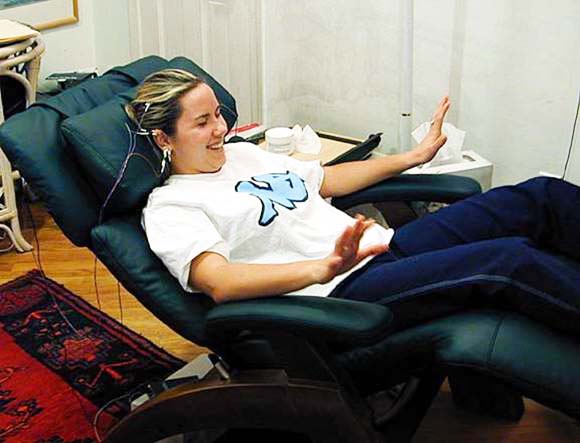
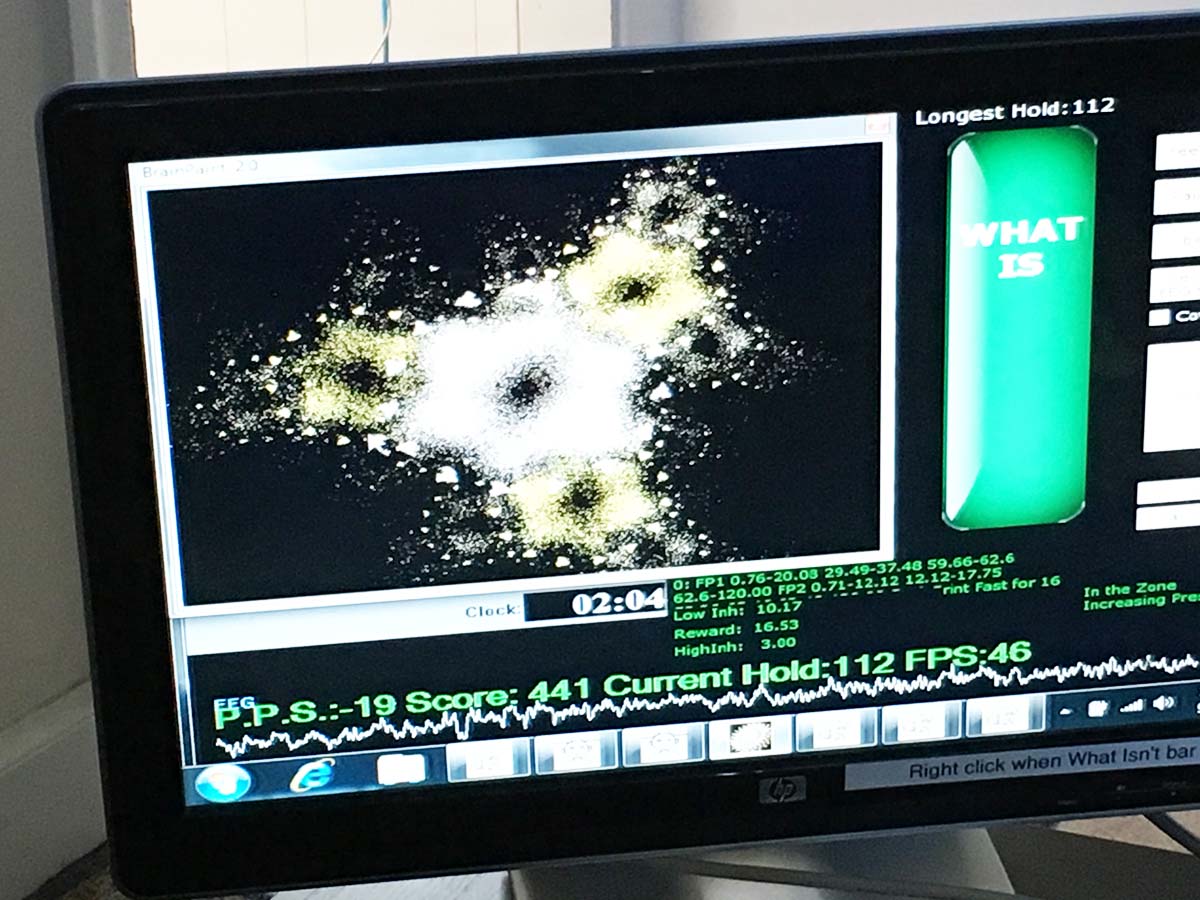
Imagine wearing a headset and playing a video game that only 'goes'
when you are learning to increase the brain waves associated with focus
and concentration.
Neurofeedback is a kind of biofeedback which uses a sensor and amplifier
to detect the brain's electrical signature so that it can be seen, and
thereby controlled. By watching your own neural activity occurring, and
gaining control over the brain waves you are producing, you gain greater
mental resilience and flexibility. You naturally develop better coordinated
neural activity. Multiple and myriad benefits are typical, without any
unwanted effects.
The educational benefits apply to all students including athletes, gifted
students and those with myriad special needs. Neurofeedback yields permanent
improvements in attention, learning, and memory. It is used by the U.S.
military, business, athletes and performers to consistently achieve top
performance, summon profound concentration, and apply greater mental power
to solve complex problems.
There are several hundred scientific studies showing complete and permanent
elimination of ADHD, learning problems, and numerous neurological disorders
which cripple learning. The process is beneficial for everyone to improve
focus and concentration. Over the past 30 years neurofeedback has proven
completely safe in all cases.
IQ boosts of 10-20 points are typical in certain special needs groups.
No other training or intervention of any kind has so substantially reduced
students' need for pharmaceuticals such as Ritalin. No other technology
is as promising to reduce the cost of providing a higher quality education
to all students. No remedial or didactic program has such compelling supportive
data to fulfill the President's vision of leaving no student behind.
Several impressive organizations have embraced this technology due its
extraordinary results. But because the underlying paradigm in new, institutional
acceptance and definitive research funding has been slow. The worst that
can be said is that more research is warranted.
There are many reasons to get out in front early of this wide open trend
thundering at you soon. This may be the first you've heard of neurofeedback,
but it will not be the last.
A simple investigation on Google using terms such as 'Neurofeedback,
QEEG, Lubar, ADHD, or 'peak performance' will be very revealing and convincing
of claims made here.
The Broad Range of Benefits to Students from Neurofeedback
Neural Awareness for Mental Self-Regulation.
Biofeedback is learning. Using some kind of mirror for awareness of a
function, control of that function ensues. It works on the principle that
if you can clearly see or hear continuous real-time output of a bodily
function such as muscle tension, temperature, or blood pressure, then
you can learn to manipulate it. Neurofeedback is biofeedback that uses
an EEG to display the weak electrical by-product which all live brains
emanate. Some sensors on the scalp can read blood flood in the brain instead
of the electrical echo.
Thus, neurofeedback is simply mental activity awareness training. With
awareness comes the ability to control brainwave output and opens the
possibility for self-regulation. Real time observation of brainwaves leads
to improved control for greater resilience and flexibility of well coordinated
neural activity. It can look and feel just like playing a videogame with
your mind while wearing a special headset.
Neurofeedback has consistently been shown safe and effective in improving
self-regulation of neural activity in children of all ages. The benefits
are numerous, diverse and profound. The myriad benefits are obtained by
all kinds of students.
Of special note, on the one hand, are student athletes and gifted students.
The US Army academy and U.S. Olympic program have embraced neurofeedback
to optimize peak performance at will.
There is also ample evidence of substantial benefits for those with attention,
behavioral, and learning deficits. There is definitive scientific evidence
of partial or complete remediation of problems for those with ADHD, learning
disorders and myriad neurologically-based disorders. To examine this evidence,
simply open a search engine such as Google and enter the terms "Neurofeedback"
or "QEEG" and any other term of interest. QEEG stands for Quantitative
ElecrtoEncephaloGraph which is a data intensive brain map used for diagnosis.
Caution: There are over 500 high quality scientific journal articles on
neurofeedback or EEG biofeedback.
Nearly all students can derive either intellectual, social, emotional,
or physiological benefits from optimizing neural functioning through explicit
biofeedback training.
Schools are the Primary Brain Altering Institution.
Learning alters brains. Schools fulfill their duty to create complex and
sophisticated neural networks inside our children's heads. They alter
the structure of each child's brain in hundreds of ways every day of the
week. And we are grateful. So why not own the neurofeedback technology?
Here is a principle worth fighting for. If a physician does neurofeedback
in her office, it is medicine. If a psychologist does it, it is therapy.
If a teacher (or teacher's aid) does neurofeedback in school, then its
education.
A school does not need special permission to fulfill its mission. Teaching
brain wave control is just like teaching how to learn. That's exactly
what it is - training to enhance education in general.
Neurofeedback is safe enough to approved by the FDA for unregulated use.
When done properly, there is little to no risk in this form of learning.
But choices do have to be made, so the work might be supervised by certified
professionals, but run day-to-day by teachers' aids. In competent hands,
it is reasonable to expect that 60-90% of all students, will experience
permanent educational benefits ranging from subtle to exceptional.
The most likely benefits are enduring increases in the ability to concentrate,
focus, learn, remember, and make complex decisions. Many other benefits
are commonly reported. For example, IQ increases of 10-20 points are common
in certain special needs groups. This result is considered by some to
be a combination of remediation of a certain reading or attentional difficulty
plus generalized improvement in neural functioning.
Quickly Self-Funding, and then Cost Saving.
Special education students make disproportionate use of costly resources.
The cost of implementing a neurofeedback program is not only small, but
it is self-funding. The money to pay for the EEG equipment, software,
and trainers are recouped in the cost savings of mainstreaming special
education students. This effect will be apparent, even obvious, in any
group of students, within a few months of training in school. Even a pilot
program should yield net cost savings within one year.
No other kind of method has so substantially reduced students' need for
pharmaceuticals such as Ritalin. No other technology is as promising to
enlarge the academic prospects of children with learning handicaps. There
is no alternative program, remedial product, or didactic curriculum which
can make claims this credible and promising to fulfill the President's
vision to leave no child behind.
The State of the Art is Continuing to Develop.
Neurofeedback is not a new technology. It is not a popular technology.
Longitudinal studies for ADHD are now older than the term ADHD (20 years).
The results typically show that 90% of students experience complete and
permanent relief of symptoms. Enter "Lubar ADHD" in Google.
There are a few theories about how and why it works. But our brains may
not be complex enough to understand the complexity of our brains. Compelling
to many are the before and after brain maps done with QEEG, SPECT, LORETTA,
and other brain imaging techniques. The math and physics are esoteric,
but the before and after pictures are obviously more balanced, healthy,
and robust. My opinion is that the body will choose health and reject
dysfunction when shown how.
Thousands of practitioners all over this nation are performing miracles
(according to the Moms) in just 40 sessions. The field is specialized
and developing rapidly. Experts are not of one mind on several topics.
Advanced and skillful practitioners prefer certain nuances to approaching
neurofeedback treatment and there is a lively debate about optimizing
training methods. Some seek to reduce the number of sessions while others
seek to derive all possible benefits. Several hardware vendors and software
technologies claim similar results.
There may not be one 'best' approach now. There are not enough well-funded
research studies to have settled all these issues. But any of these issues
are all minor points when compared with the big picture: massive educational
benefits and savings await the willing. Courage and leadership will be
rewarded. This is an international opportunity for excellence.
How Much Neurofeedback Should We Start
and How Soon?
There are three primary issues when considering adoption of any neurofeedback
proposal. Safety, effectiveness, and the evaluation process.
Safe.
When conducted by volunteers or professionals, there is no credible
problem with safety. Even in a partially self-insuring district with a
litigious population, risk is not an issue. No court has ever awarded
damages for neurofeedback since its inception in 1970. The only real potential
litigation problem is NOT adopting neurofeedback in a timely manner, or
in rejecting it unfairly.
Effective.
Hundreds of studies and thousands of testimonials say this is no placebo
effect. Despite the evidence of effectiveness, there are not plenty of
neurofeedback programs in schools in surrounding districts. The worst
that can be said is that neurofeedback is experimental. There are only
500 peer reviewed journal articles with results that range from mild to
extraordinary. The big, definitive multi-university, randomized, replicated,
double-blind, prospective, controlled scientific study has not yet been
funded. We could be a major factor in the coming revolution. This is a
highly significant opportunity in all respects.
Evaluation.
The only expert competent to judge neurofeedback is one familiar with
the specific technologies. This kind of proposal has been defeated in
other districts because of uniformed and erroneous criticism by experts
without expertise. In other districts, it has languished because decision
makers had no clear criteria to evaluate degree of effectiveness required
for adoption. When a proposal is new or strange, it is subjected to extraordinary
levels of fit and proof which apply to no other decision.
In still other districts, those who saw a proposal die, do not say why.
Therefore, an open process of evaluation by those qualified in the science
and practice of neurofeedback is essential. Reasonable criteria for adoption
should be recognized early and then honored in the light of day. The results
of fair pilot studies should determine the degree of subsequent steps
toward greater use of neurofeedback in the a School District. The risk
is nil, the upside extraordinary in many ways.
Adopting neurofeedback to any degree requires courage, vision, and openness
to good ideas which aren't entirely understood. The potential rewards
are awesome. The risk of inaction is merely unfortunate.
Conclusion:
Self-controlled brain wave training has benefits to offer special education
students, athletes, gifted students, and all students. There is substantial
scientific evidence of complete remediation for those with attention deficits
and myriad learning disorders. The largest benefit is for normal students
in form or greater ability to focus on learning.
It is believed that all students can derive either intellectual, social,
emotional, or physiological benefits from optimizing neural functioning.
There is no risk of harm or downside to this form of learning. In 80-90%
of all students, permanent health and educational benefits range from
subtle to profound. Most often cited are enduring increases in abilities
to concentrate, focus, learn, remember, and make complex decisions. Other
benefits such as improvements is sleep are commonly reported. IQ increases
of 10-20 points are typical in certain special needs groups. Nothing else
does that.
No other educational program, therapy, or treatment (except perhaps correcting
some deficiency) has proven claims to reduce or totally eliminate ADHD
students' need for pharmaceutical stimulants such as Ritalin. No other
technology is as promising to reduce the cost of providing a higher quality
education to all students. No remedial or didactic program has proven
this effective in fulfilling the President's vision of leaving no student
behind.
Beware of expert provincialism, defensiveness, unwarranted caution, and
unrevealed economic motives for squelching enlightened forward movement.
For example, psychiatry has well funded studies proving drugs are a temporary
remedy for ADHD. The drugs don't work for everyone and there are significant
deleterious effects to powerful stimulants. Therapy based on interaction
with child psychologists lack the kind of scientific verification for
safety or effectiveness enjoyed by neurofeedback. They are naturally in
conflict with a technology that can end their usefulness. There are no
outspoken critics of neurofeedback who don't have conflicts of interest,
such as livelihood or having received pharmaceutical funding. The entire
field is due for a paradigm shift.
Every claim in this paper is easily verified with an internet search
engine. All the errors and a couple of the opinions are from Gary Ames.
I hope you found this introduction useful and that it impels you to rapid,
courageous, and dramatic action.
Focus and Attention Building with
Computer Assisted Training (FABCAT)
By Gary Ames 610-668-3223
Focus and Attention Building with Computer Assisted Feedback (FABCAT)
is a generic name for a type of education used in over 300 school systems.
Efficacy of attention training with students has had compelling evidence
since the 1970s (see J. Lubar 1970). The hard science research results
are now indeed impressive with the number of studies and successful students
doubling each year.
Statistics now include a correlation of r=.75 between score on TOVA and
hours of training. The magnitude is 1.12 TOVA points per hour of FABCAT
training. (T.O.V.A. Test of Variable Attention, a continuous performance
test.)
Training ADHD Away
Specific educational research within school settings dates back to 1991
at the "New Visions School" and "A Chance To Grow,"
in Minneapolis. They have gathered very nice research data over the years.
You can also see some research results at www.PlayAttention.com. They
estimate that for Special Ed students solely with attention problems,
approximately 75-80% can be mainstreamed within one year. Recently, controlled
scientific studies (Monastra, 2001) have proven that about half of those
with ADHD can completely end their use of stimulant medications.
FABCAT works
In most studies, success rates vary between 60-90% of ADHD students
who complete 40 hours of training sessions. Students show significant
results in improved alertness, focus, and attention using any standard
test. Results are readily measured with IVA, behavioral measures, classroom
charts, and in reduced requirements for medication.
Once attention improvements are attained, the students' improved capacity
for learning is sustained. Related behavior issues dissolve. There are
only occasional requests for booster sessions.
Staff
Any Teacher, Aide, or Volunteer can be an Attention Coach. Training
the Trainer can be self-study with videos, and takes as little as 2-4
hours. Phone support is required by PlayAttention. Other suppliers have
different equipment, nuances, and support arrangements. Certifications
are offered but not required.
Schedule
One FT Attention Coach meets with each student for 30-40 minute training
session 2 times per week. At 6 sessions per day with 24 students, yields
about 70 sessions per student within one school year which is about 40
hours of training per student, per year.
Range of Sessions
The Attention Training generally yields very noticeable changes within
a few months. Some Special Ed. students can be mainstreamed after one
semester. Normal and gifted students and athletes usually required fewer
sessions to notice greater mental focus and the capacity to concentrate.
Look of FABCAT
Each session looks like the student playing a video game. The student
might wear a light plastic helmet that provides data to the computer about
the degree of attention devoted to the current task. That feedback affects
the display so the student can learn what works to succeed in the game
by gathering fuller attention.
Feel of FABCAT
The student experience is typically described as pleasant or interesting.
Students typically feel more alert at the end of a session. This learning
is consolidated over time, generalized, and becomes a preferred way to
attend to the world at large.
Content of PlayAttention
In most of the FABCAT approaches, training content is irrelevant. It
is the capacity for focus and attention which is trained with computer
assisted feedback. PlayAttention trains with 6 kinds of attention tasks
as video game subject matter: Attention, Visual tracking, Discriminatory
Processing (what's important now) Attention Stamina, Time on Task, Short
Term Memory (sequencing). While this content has some intuitive appeal,
it may not be more effective than other approaches, even on these particular
tasks.
Effects of FABCAT
The improved skill at focusing and attention is universally preferred
by the student, teachers, administration, and parents. It only hurts the
pharmacist because the need for Ritalin, Adderall and other attention
medications often declines or is no longer needed, at all. There is no
risk associated with FABCAT training, there are often health related or
behavioral benefits, such as sleep and defiance.
Cost of FABCAT
The cost for various kinds of equipment range between $2-5000 plus one
computer each and one Attention Coach for about 24 students. Some equipment
needs old computers, while others make full use of the latest technology.
Setting up a room with multiple Computerized Attention Trainers can handle
a higher volume of students with just one Attention Coach. The upper limit
is about 10 Training Units and 10 students at a time coming in at specific
intervals. Add more Coaches with equipment and there is no limit.
Getting started with FABCAT
Baby steps
Schools can begin with one or two training units and train one or two
staff. After one semester the benefits can be observed and decisions to
expand the program are made on firmer footing. For certainty of early
success, Play Attention has a strong implementation track record in schools.
At full utilization, calculate: $3000 for Play Attention, one used computer,
one Attention Coach for 25-40 students per year. Naturally, there can
be a part-time commitment for trial purposes to reduce staff expense.
Both feet
A more ambitious beginning is to purchase an array of equipment from several
vendors. Each approach has its own merits. Here you provide training as
appropriate to each approach, and simultaneously implement some in each
school.
Since every approach works, the diversity yields the broadest local knowledge
base. The experience fosters the most informed assessment and best next
step. Assume $2-5000 per training unit. There is merit to paying $4000
per pupil which includes outside services to ascertain very specific training
protocols.
Benefits of FABCAT
The training is directly in line with school's mission and mandates.
Since attentional difficulties adds significant cost and effort, for both
learning and teaching, any relief is multi-faceted. The most financially
tangible benefit is in mainstreaming special education students. The return
on investment is attractive by any criteria. Beyond mainstreaming those
with attentional issues, all students can benefit from FABCAT training.
Delighted students, parents and teachers are to be expected.
Questions for School Officials
by Gary Ames
Neurofeedback is mental focus and attention training using computer assisted
feedback. It involves a new paradigm, I want to ask about your record
of support and core principles. What is your approach when considering
a new educational program?
Please think about educational initiatives or learning programs you have
already supported and opposed. Can you list some on both sides?
What evidence, issue, or reason placed it on one side or the other?
1 a. Supported adoption of program. - Reason
2 a. Supported adoption of program. - Reason
1 b. Opposed adoption of program. - Reason
2 b. Opposed adoption of program. - Reason
Have you established a minimal proof requirement for new initiatives?
What evidence quality, authority, diversity of scientific research, prestigious
recommendations, etc. are proper for the District's approval process?
How much is enough for you?
What factors into the return on educational investment and makes for
a "go decision"? What is your test of support or your cost /
benefit effectiveness formula?
If a safe and effective learning initiative with extraordinary promise
for dramatic benefits for all students (especially those most in need
and the most expensive), and that:
fits into the District's Mission,
folds neatly into the Strategic Plan,
furthers the Vision (in a foundational way),
is self-funding within a short time,
and meets many of the Goals that the District has laid out -- what else
do you need?
What does "data driven decision making" mean to you?
Do you believe in delegating authority and control down to lower local
levels for implementation, while retaining responsibility and oversight?
Everyone agrees that neurofeedback is safe. Or can easily be even safer.
What history, assurances or comparisons do you require?
What would it take for you to believe it enough to remove the issue as
a barrier?
The 'Chicken Little" limit is the line below which a threat is not
worth worrying about. There have been zero court awarded judgements for
damages since inception in 1970 caused by any of the 3000 neurofeedback
practitioners. Does the number zero meet the Chicken Little threshold?
Do you believe we will need a larger room to hand out end-of-year awards
after adopting a broad neurofeedback initiative? What award categories
will be impacted?
True or False:
When a teacher does neurofeedback training, it can be called "education".
Is that a case you feel comfortable/passionate about making?
How would you challenge the critics of neurofeedback who say neurofeedback
is:
"Not education."
"Only experimental."
"We are not licensed for that."
"That's a medical procedure." or "We don't do therapy."
"Everyone would have to sign a waiver."
"Not safe enough ... insurance and litigation problems."
"No darn good."
"Balderdash!"
Do you feel the District needs any special parental permission to fulfill
its mission using neurofeedback?
What delays and barriers are expected and what is too much?
Do you support a broad and dispersed pilot program introducing multiple
kinds neurofeedback applications in several schools, (all at about the
same time), to get a diverse and useful base of experience for the second
stage? If not, why not. If not, when?
Do you feel that the brightest students and regular students should be
an important group for initial introductions to ensure that neurofeedback
does not get a "special" reputation?
WHO IS QUALIFIED TO COMMENT?
Paradigm shifts are uncomfortable. Experts in education, science, medicine,
Special Ed., ADHD and learning disorders have their history, reputation
and practices at stake when they admit that: something very different
from what they do, is rather good. Can you list the kinds of financial
conflicts of interest that would disqualify a nay-sayer or must be disclosed
as part of their input?
Who should be allowed, and not allowed to register an unbiased concern?
What qualifications must someone possess and not possess to advice the
District?
How much evidence, of what kind, from what source, with what consistency,
would it take for you to support neurofeedback? What is your criteria
that must be met?
CURRENT PRACTICES
Post hoc, ergo proctor hoc.
This is a Latin phrase meaning "after the fact, therefore because
of the fact."
This is the rationale always used in an educational outcome study.
"We did this, and look how well it worked!"
In formal logic, 'Post hoc, ergo proctor hoc' is the name of a
logical fallacy.
The explanation is that everything has multiple causes. To identify just
one "reason for" a change within a complicated system is not
supportable logically.
What evidence besides outcome studies does the District use as proof
for effectiveness when adopting or deciding to continue programs?
The following programs were adopted by and are currently supported by
my School District for Special Needs. By what process, and with what criteria
of proof, were the following educational programs deemed acceptable to
the District?
Orton Gillingham,
The Wilson Reading System,
Fast Forward,
Lindamood-Bell,
Resource Room,
Instructional Support Lab,
SRA,
REACH,
N.O.W.
P.R.I.D.E.
Specialized Learning Support,
Adaptive Instructional Technologies.
Do any of the current special education programs regularly demonstrate
reduction of medication?
Do any report 10 to 20 point IQ jumps as commonplace?
Are we even sure they are better than nothing?
What evidence of effectiveness justifies the continuation of a current
program?
Which ones are due for withdrawal of support, to fund more promising initiatives?
By what criterian will you decide your support? What trusted experts
would you consult and what qualifications must an advisor have to be an
expert? How specifically knowledgeable on neurofeedback itself must a
resource be, to still be credible and heeded? How naïve in the actual
practice can an 'expert/advisor' be?
During the 2003 election, The President of my School Board told me he
knows neurofeedback works -- he's personally seen it. He was glad the
current administration was aware of neurofeedback. The School Board President
and his team won the election and welcome citizen support.
I do not seek a commercial relationship nor a business endorsement from
my District. I consider it a patriotic duty to advocate neurofeedback.
In 1968 my draft status was 1-A, but I was never invited to war. Many
of my generation who did take arms, still suffer trauma. Neurofeedback
is an effective remedy for PTSD and fuels my determination for broad acceptance.
|